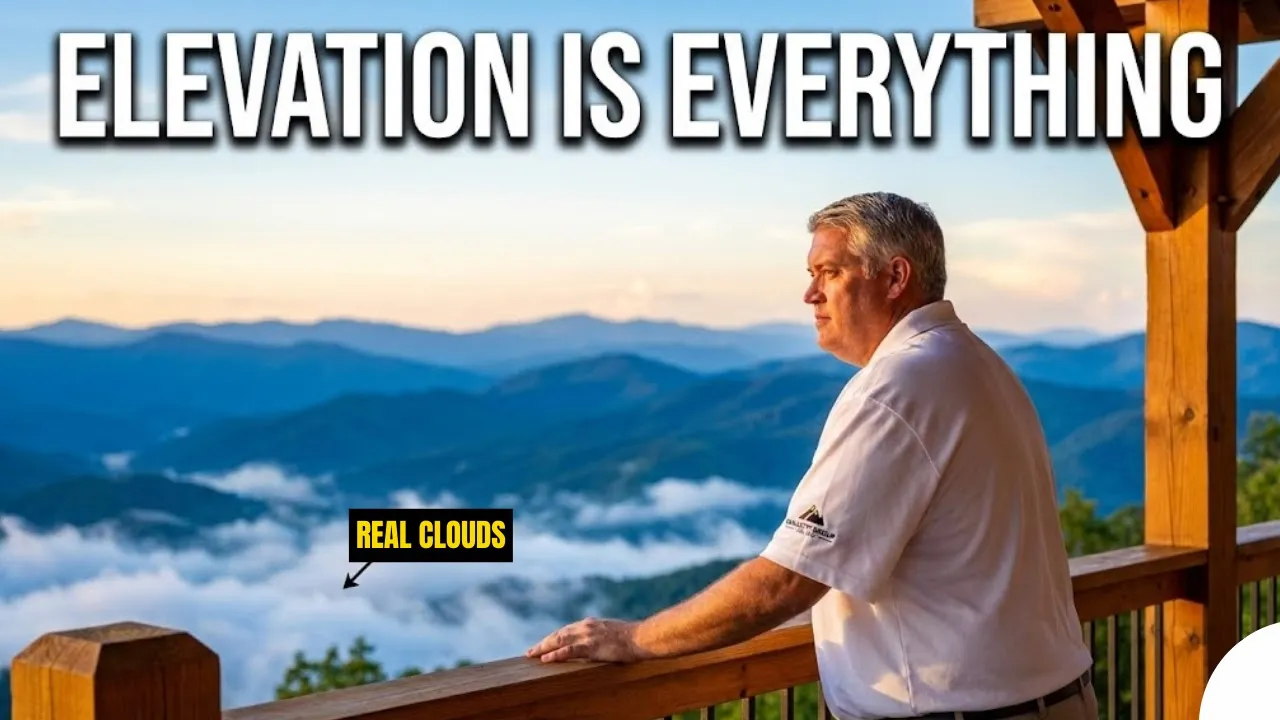
If you’ve ever stepped out of your car for the first time in the North Carolina High Country, you already know what I’m about to describe.
Buyers expect cooler air. They expect views. What they don’t expect is the pause.
It happens almost every time. The door opens, feet hit the ground, and there’s a moment where nothing is said. Not because anyone is tired or stretching after the drive, but because something feels different. That moment is what I call the first breath, and it’s where elevation starts to matter in ways most people don’t anticipate.
The First Breath: When Elevation Introduces Itself
The first breath is quiet. And quiet isn’t really a sound; it’s a mental shift.
The air is cooler, lighter, and crisper, especially in the summer. For buyers coming from Florida or other humid climates, shoulders drop almost instantly. Conversations slow down. The environment does the work before the house ever gets a chance.
What’s interesting is that buyers often stop talking about square footage or floor plans at this stage. Instead, they start noticing how they feel. That’s when it becomes clear that elevation isn’t just a feature. It’s emotional.
Why Elevation Equals Emotion
You can remodel a kitchen. You can update bathrooms. You can even rework a floor plan. What you can’t manufacture is elevation.
Long-range views, clouds drifting past your deck, cool mornings that invite you outside with a cup of coffee, those are permanent. At elevation, days start differently. Phones stay face down longer. Sunrises stretch across ridgelines instead of rooftops. Evenings last longer because you’re not rushing inside to escape heat or humidity.
Homes at elevation tend to do exactly what they’re meant to do. They bring people together. Conversations linger. Meals stretch. Memories stack up quickly.
A Buyer Who Didn’t Fully Get It… Yet
I worked with a couple last year who knew they wanted the High Country, but hadn’t yet realized how much elevation would influence their decision.
They focused heavily on finishes, layouts, and square footage. All reasonable priorities. We toured a home that checked every box on paper. Great layout, beautiful finishes, ideal size.
The next day, we saw a nearly identical home. Similar floor plan. Similar quality. The difference was elevation.
We didn’t make it to the front door before the wife quietly said to her husband, “This is the one.”
The views opened up. The breeze moved through the trees. The house simply felt different. Two similar homes. Two completely different experiences. Elevation was the difference.
This happens often in areas like Banner Elk, Beech Mountain, and Sugar Mountain, where small changes in height can dramatically change views, temperature, and overall feel. Blowing Rock and Boone benefit from elevation too, the whole High Country does!
When Elevation Becomes Too Much of a Good Thing
That said, elevation can be overemphasized.
I worked with another buyer who became fixated on elevation numbers. We toured homes in high-elevation communities like Eagles Nest, where some homes sit well above 4,000 feet. Their vehicle even displayed elevation, and each showing became a comparison of numbers rather than lifestyle.
Later, we toured homes in Blue Ridge Mountain Club. The community checked nearly every box: location, amenities, homes, and overall experience. Elevations there typically start around 3,500 feet and roll downward.
The challenge was perception. Even though the temperature difference between 3,500 and 4,500 feet is often only a few degrees in summer, the number had become the deciding factor. Elevation matters, but there’s a point where views, access, community, and livability matter more.
What Elevation Typically Costs
Homes with true long-range views and meaningful elevation are usually found at higher price points. In most cases, you’re looking at the million-dollar range and up, with plenty of room to go higher depending on location, views, and finishes.
Buyers seeking elevation aren’t chasing utility. They’re investing in experience and lifestyle. These homes tend to hold value well because elevation and views are finite. Climate patterns also continue to push buyers toward cooler summer environments, which further supports long-term demand.
Elevation as a Long-Term Investment in Lifestyle
Elevation has a way of bonding you to a place. After one summer in the High Country, it tends to stay with you. These homes rarely sit idle during peak seasons. They become gathering places. Traditions form. Family rhythms change.
If elevation is part of what you’re imagining for your mountain or second home, the details matter. Which communities offer it consistently? Where do the views open up? Where does the lifestyle fit the way you actually plan to live?
If you’d like help narrowing that down, I’m happy to put together a custom search, walk you through communities, and help you rule in and rule out options that align with what you’re really looking for.
We share High Country lifestyle content weekly, and if this topic resonated with you, I’d love for you to subscribe to our YouTube channel: Guillette Group - High Country and/or reach out. Let’s have a conversation and see what elevation could look like for you.